


Japan inaugurates its first osmotic power plant in Fukuoka
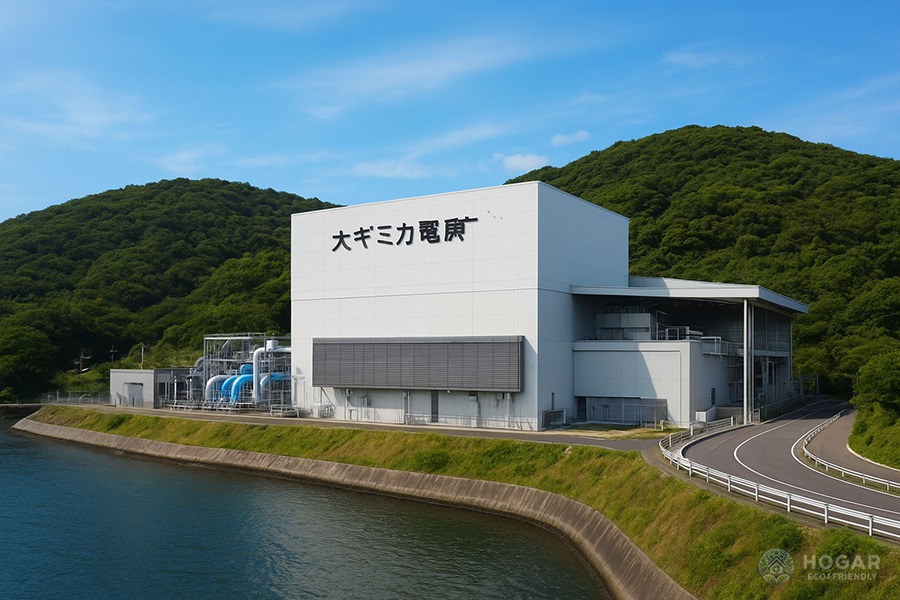
Japan has taken a firm step towards the energy transition with the inauguration of its first osmotic power plant, located in Fukuoka Prefecture, in the southwest of the country. The project began operating on 5 August 2025 and marks a milestone in the use of renewable energy, as it relies on a technology capable of generating electricity continuously, without depending on weather conditions, sunlight or wind strength. With this initiative, Japan not only diversifies its energy mix, but also positions itself at the forefront of innovative natural resource use.
What is osmotic energy and how is it produced?
Osmotic energy, also known as salinity gradient energy, arises from the natural phenomenon that occurs when freshwater and saltwater come into contact. The difference in salt concentration creates osmotic pressure that can be converted into electricity.
The process relies on semi-permeable membranes. These allow freshwater to pass towards the saltwater side in an attempt to equalise concentrations. This transfer generates pressure that is channelled into turbines connected to generators, producing clean and continuous electricity.
What is particularly interesting in Fukuoka is that the plant does not rely solely on rivers and seas. It uses recycled and treated water together with concentrated brine, a by-product of the desalination process. In this way, resources that are usually considered waste are reused, improving efficiency and increasing the salinity gradient needed for higher energy output.
Estimated production and applications
The Fukuoka plant is capable of producing approximately 880,000 kilowatt-hours per year, enough to meet the needs of around 220 average Japanese households. Although this figure may seem modest compared to large solar or wind farms, its real value lies in the consistency of its output, as it does not depend on sunshine, wind or rainfall.
In addition, much of the electricity generated will be used to power the region’s desalination plant, ensuring a stable supply of drinking water for Fukuoka and surrounding areas. This dual benefit—clean energy and secure water supply—makes the project a clear example of technological integration and applied sustainability.
Advantages over other renewable sources
Osmotic energy offers several strategic advantages that distinguish it from solar or wind power:
-
Continuous operation: it does not depend on natural cycles such as day and night or on weather conditions.
-
Zero carbon emissions: it is a clean energy source that helps reduce greenhouse gas emissions.
-
Complementarity: it can act as a stable base load, supporting the grid alongside other renewables.
-
Use of residual resources: the use of treated wastewater and concentrated brine adds value from a circular economy perspective.
For Japan, which imports much of its fossil fuels, this technology represents a strategic opportunity to reduce external dependence and move towards a low-carbon economy.
Background and international outlook
Although innovative, the Fukuoka plant is not the first of its kind worldwide. In 2023, Denmark launched a pilot facility in Mariager, considered the first to demonstrate the viability of osmotic energy at an industrial scale. However, the Japanese plant is larger in size and designed with an urban and public service integration approach, making it a more ambitious project.
Beyond Japan and Denmark, several countries have experimented with prototypes and pilot projects, including Norway, Spain, Qatar, South Korea and Australia. While some programmes slowed in recent years, technological advances and climate urgency have renewed interest in this solution.
Technical challenges and paths for improvement
Like any emerging technology, osmotic energy faces challenges that must be addressed for large-scale adoption:
-
Internal energy consumption: pumping freshwater and saltwater into the system requires energy, reducing net efficiency.
-
Membrane friction: membranes suffer performance losses due to resistance and wear.
-
Infrastructure costs: as an emerging technology, it still requires higher investment than more mature options.
Nevertheless, more advanced membranes are being developed to reduce friction and allow higher water flow. Work is also underway on more efficient pumping systems and the use of highly concentrated brine, which increases the salinity gradient and boosts power generation. These advances strengthen the technical and economic viability of future projects.
Impact and future outlook
The inauguration of the Fukuoka plant is seen as a turning point on the path towards a cleaner and more balanced energy mix. It not only validates osmotic energy as a real alternative, but also opens the door to expansion in other regions with similar conditions, such as river mouths, coastal areas or locations with desalination plants.
If the technology can be scaled up, osmotic energy could become a key resource to complement solar and wind power, adding stability to the grid and reducing reliance on fossil fuels during periods of low renewable generation.
For developing countries with access to large freshwater bodies and coastlines, this innovation offers a major opportunity to move towards clean and sustainable energy independence.


