


Madrid breathed polluted air throughout 2024 above EU limits
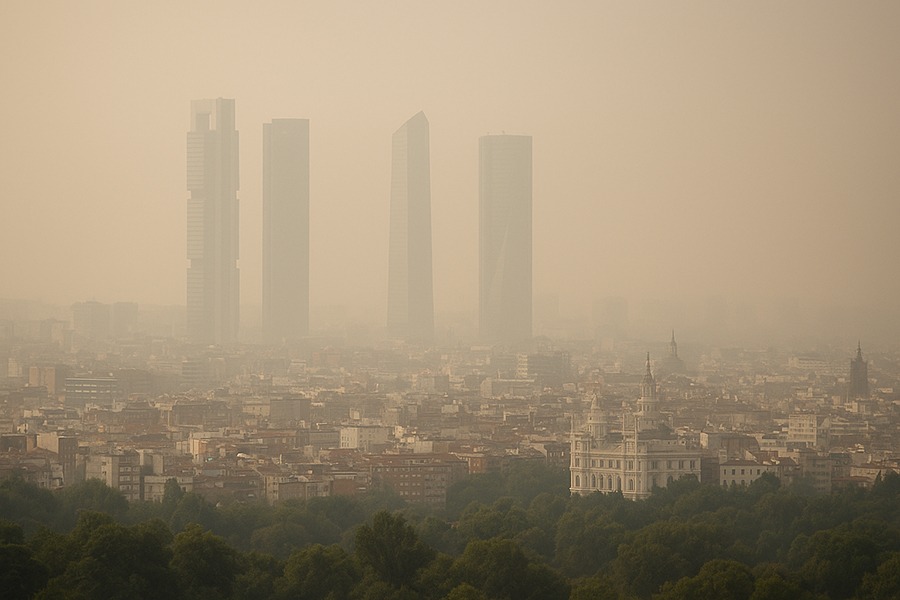
During 2024, the Community of Madrid experienced a year marked by a major environmental and public health problem: its entire population breathed air polluted above the limits set by the new European legislation for 2030. This situation, affecting more than seven million people, not only compromises quality of life but also represents a real health risk and an economic burden worth billions of euros.
Despite some progress in common pollutants such as particulate matter or nitrogen dioxide, the rise in tropospheric ozone during the hottest months raised serious concerns. This gas, known as a secondary pollutant directly linked to climate change, became the main negative protagonist of the year.
General context
The analysis based on data from monitoring stations across the region shows that Madrid’s residents breathed air exceeding the new thresholds established by the European directive approved in 2024. This means that, although progress was made in some areas, the region continues to broadly fail to meet air quality targets.
When comparing 2024 pollution levels with previous years—including those before the pandemic—significant reductions are observed in PM₁₀, PM₂.₅ and nitrogen dioxide. These decreases ranged from 5% to 38%, a positive sign that some measures are working. However, tropospheric ozone increased by nearly 30% compared to the previous year, reaching levels not seen for more than a decade.
Pollutants in detail
-
PM₁₀, PM₂.₅ particles and NO₂:
Although improvements have been recorded, levels still exceed those recommended by the World Health Organization and the new European regulation. These pollutants mainly originate from traffic and industrial activity, and their continued presence affects human health, vegetation and ecosystems. -
Tropospheric ozone (O₃):
This was the most problematic pollutant in 2024. Summer heatwaves favoured the formation of this gas, which is not emitted directly but results from chemical reactions between other pollutants under solar radiation. More than 200 exceedances of the information threshold were recorded, affecting both the city and its metropolitan area.
Factors that worsened the situation
The origin of pollution in Madrid is closely linked to two main sources:
-
Road traffic, particularly intense in the city centre and corridors such as the Henares Corridor.
-
Barajas airport activity, which remains a significant source of emissions and a critical point for pollutant dispersion.
In addition, a decisive climatic factor played a role: 2024 was one of the warmest years ever recorded in the region. Atmospheric stability in winter favoured particle accumulation, while intense heatwaves in July and August pushed ozone levels up. This link between high temperatures and pollution shows how climate change is intensifying air quality problems in cities.
Institutional response and shortcomings
Legislation requires administrations to develop Air Quality Improvement Plans, but many remain unapproved or do not include specific actions to tackle ozone pollution.
The Low Emission Zones implemented in Madrid have shown limited results: their territorial scope is small, enforcement is weak and the lack of effective penalties reduces their impact. This lack of decisiveness has even led to legal actions demanding stronger institutional measures.
Impact on health and the economy
Air pollution is not only an environmental issue, but also a serious public health problem. Studies estimate that around 30,000 people die each year in Spain from diseases linked to poor air quality, of which approximately 5,400 correspond to the Community of Madrid.
The economic cost is equally alarming: healthcare expenses, productivity losses and welfare damage exceed 50 billion euros nationwide, equivalent to around 3.5% of Spain’s GDP. In practical terms, breathing polluted air is extremely costly for both individuals and society.
Children among the most vulnerable
A particularly worrying aspect is the impact of pollution around schools. Measurements taken at school entrances in Madrid and nearby municipalities detected higher pollution levels than those recorded by official stations. This highlights how exposed children are, a population group that is especially sensitive because their lungs are still developing.
Conclusion and call to action
The 2024 assessment leaves a clear conclusion: air pollution in Madrid remains a public health and environmental emergency. Despite partial improvements in some pollutants, the overall situation worsened due to the rise in tropospheric ozone and the lack of strong, sustained measures.
If Madrid wants to move towards a healthier and more sustainable future, it will be necessary to:
-
Strengthen Low Emission Zones so they are truly effective.
-
Drastically reduce polluting traffic and promote electric, shared and active mobility.
-
Control and limit airport-related emissions.
-
Develop specific ozone action plans, especially during extreme heat episodes.
-
Provide stronger protection for vulnerable groups such as children and the elderly.
Only through real commitment and bold policies will it be possible to guarantee clean air in Madrid, improve public health and help curb the effects of climate change.


