


Mattress recycling in Spain: Recypur’s circular solution
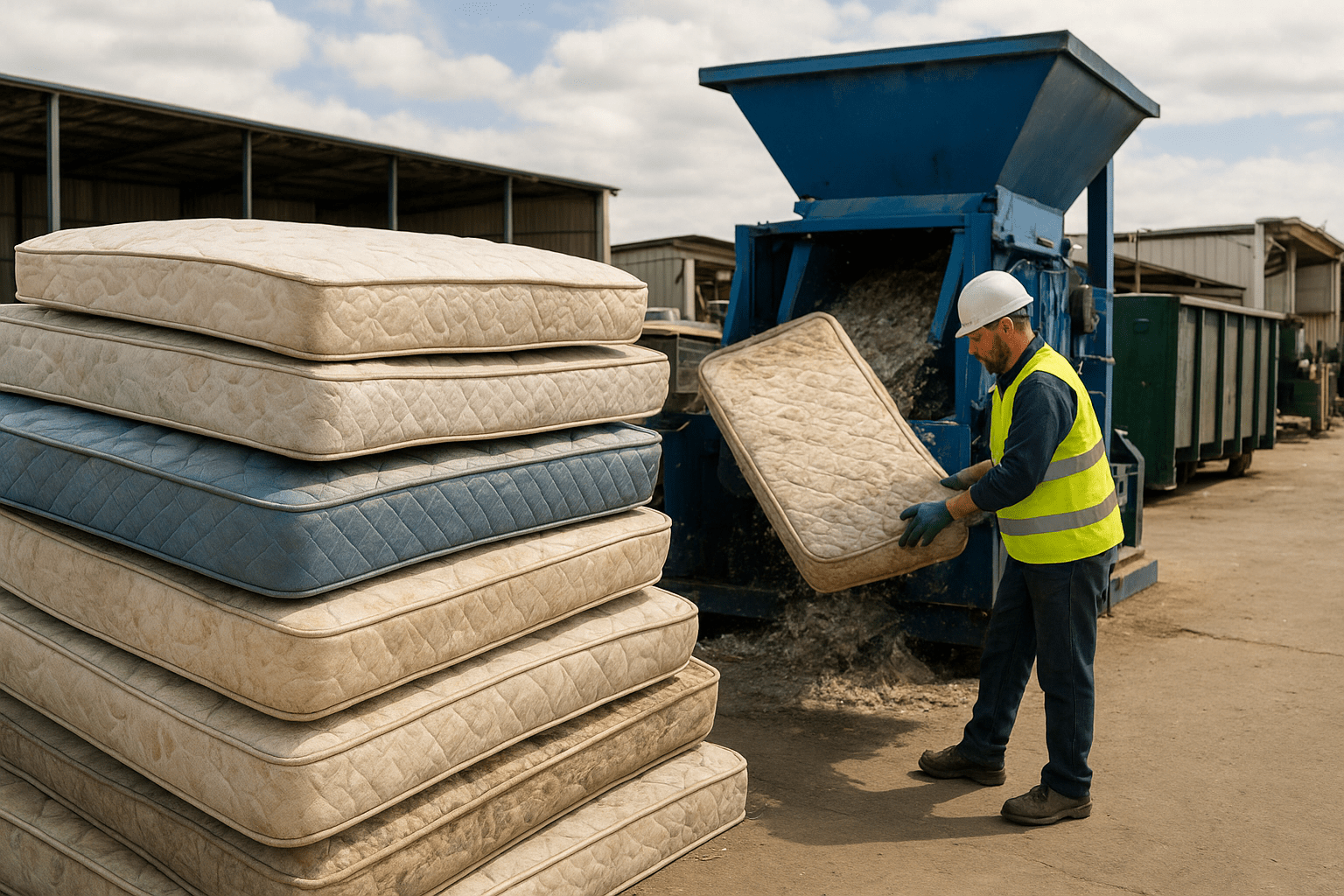
In Spain, approximately 1.5 million mattresses are discarded every year, and more than 90% of them end up in landfills, generating a significant environmental impact. Mattresses are not ordinary waste: their volume, weight and the combination of complex materials — polyurethane foam, steel springs and fabrics — make them one of the most difficult waste products to manage. This leads to landfill overcrowding and a potential risk of soil and groundwater contamination.
However, the Valencian company Recypur has developed an innovative solution to this challenge, becoming a pioneer in mattress recycling in Spain. Through a waste recovery process, Recypur transforms used mattresses into secondary raw materials that are used in various industrial sectors, from the manufacture of new mattresses to the production of acoustic and thermal panels for construction.
The challenge of mattress recycling
Mattresses combine organic and inorganic materials that do not degrade easily. Polyurethane foam, for example, is durable, flexible and insulating, but chemically complex to recycle using traditional methods. Steel springs require specific metallurgical processes for reuse, while fabrics may contain synthetic and natural fibers, complicating textile recycling.
As a result, most discarded mattresses end up in landfills, contributing to waste accumulation and increasing pressure on the environment. This type of waste is growing as Spain’s housing and hotel stock continues to expand, with a constant consumption of sleep products that have a limited lifespan.
Recypur’s solution
Recypur has developed a patented mattress recycling process that covers the entire waste management chain, from collection to transformation into new products. The company collects mattresses from private homes, hotels, hospitality chains and companies in the sleep sector, ensuring that materials do not end up in landfills.
Once at its facilities in Carlet, Valencia, the mattresses are dismantled and separated into their main components: polyurethane foam, steel springs and fabrics. Each component follows a specific process:
-
Polyurethane foam: it is shredded and subjected to a recovery process that turns it into secondary raw material. This material is used to manufacture new mattress cores, acoustic and thermal panels for construction, as well as industrial insulation products.
-
Steel springs: they are melted and processed to manufacture new metal products, contributing to the circular economy of the metal sector.
-
Fabrics: they are recycled into other textile products, reused in upholstery or converted into fibers for the construction industry, such as insulation or fillers.
This comprehensive approach not only prevents mattresses from ending up in landfills, but also maximizes the use of all components, generating significant economic and environmental value.
Innovation and sustainability
Recypur’s plant, operational since 2022, has been designed with state-of-the-art technology developed in collaboration with experts from Spain, France and Germany. The facility has the capacity to process more than 80 tonnes of polyurethane foam per month, generating over 1,200 kilograms per hour of secondary raw material, enough to produce 250,000 mattress cores and 300,000 square metres of acoustic and thermal panels annually.
The company has also obtained the first ENOR circularity certificate for recycled mattress materials, validating traceability, process sustainability and recycled material quality. This positions Recypur as a benchmark for the circular economy in Spain, proving that bulky waste can be transformed into valuable resources through innovation and environmental commitment.
Expansion and future outlook
With an initial investment of nearly €7 million, Recypur has established itself in the Spanish mattress recycling market. The company is currently planning an additional investment of €6 million to expand its activity into sectors such as construction, agriculture, footwear and sports, offering sustainable solutions based on recycled materials.
This expansion will not only diversify the range of recycled products, but also reduce the environmental impact of industry and promote the circular economy in new fields. Recycling innovation combined with certified traceability makes Recypur a model of responsible industrial and household waste management.
Environmental and social impact
The impact of initiatives such as Recypur’s goes beyond waste reduction. Mattress reuse contributes to:
-
Landfill reduction: recycling mattresses prevents landfill overcrowding and associated pollution.
-
Lower CO₂ emissions: recycling and material recovery generate fewer emissions than producing new materials from scratch.
-
Promotion of the circular economy: each recycled mattress becomes raw material for new products, closing the production loop.
-
Environmental awareness: companies, citizens and public administrations take part in the process, encouraging sustainable habits.
Conclusion
Recypur shows that mattress recycling in Spain is not only possible, but also profitable and sustainable. Its comprehensive waste management model, based on technological innovation, sustainability and circular economy principles, demonstrates how companies can turn an environmental challenge into an industrial and ecological opportunity.
The adoption of solutions like Recypur’s will allow Spain to move towards a more responsible and sustainable consumption model, where waste becomes a resource and the environmental impact of household products is significantly reduced.


